
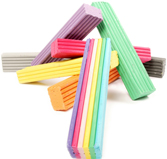


Guidance in working with Plasticine or Colourclay Animation Clay
ColourClay Modelling clay is non toxic, does not dry out and has excellent modelling properties. Newplast and Plasticine are other well known brands. Plasticine is a particular well known brand of plastic non-air drying modelling clay produced by Flair. ColourClay StaySoft Modelling Clay is an alternative modelling or stop motion animation clay for modellers to enjoy.
ColourClay is used as a non dry modelling clay as an animators clay by artists like claymation experts Wallace and Grommit. It is an excellent quality Plastic reusable clay for modelling by children too. A very useful characteristic of Colour Clay modelling clay is the fact that by kneading, it quickly softens and is very pliable during the modelling stage. On completion of the model, the clay stiffens and retains its shape. As a reusable sculptors clay, Colour Clay clay can be used for creating master works from which moulds can be made. it can then be reworked any number of times thus making it very economical.
The Trade Mark Plasticine by Flair has been used for over a century by modellers of all ages and still retains its popularity.
The similar product ColourClay is available in 20 colours, all of which are stocked by our Internet Shop at Craftmill.
The History of Plasticine From Wikipedia, the free encyclopedia.
Plasticine is a putty-like modelling material; the word is trade marked , but in Commonwealth English it is commonplace use it as a generic description. In the US, the term modeling clay is much more widely used, but in the U.K and Europe a Plasticine like material (nothing to do with Flair) is manufactured under brands such as Newplast and ColourClay. Recently Flair bought the original Plasticine brand name from Humbrol.
Plasticine was formulated by art teacher William Harbutt of Bathampton, near Bath, England in 1897. He wanted a non drying clay for use by his sculpture students. Although the exact composition is a secret, Plasticine is composed of calcium salts (principally calcium carbonate, i.e. chalk), petroleum jelly, and long-chain aliphatic acids (principally stearic acid). It is non-toxic, sterile, soft, malleable, and does not dry on exposure to air (unlike superficially similar products such as Play-Doh, which is based on flour, salt and water). It cannot be hardened by firing – in fact, it is flammable and attempts to harden it by heating may be dangerous.
A patent was awarded in 1899, and in 1900 commercial production started at a factory in Bathampton. The original Plasticine was grey, but the product initially sold to the public came in four colours, and it was soon available in a wide variety of bright colours. Plasticine was popular with children, widely used in schools for teaching art, and found a wide variety of other uses like for example, moulding for plaster casts and prototype modelling. The Harbutt company promoted Plasticine as a children’s toy by producing modelling kits in association with popular children’s characters such as Noddy, the Mr Men and Paddington Bear.
The original Plasticine factory was destroyed by fire in 1963 and replaced by a modern building, and production in Bathampton by the Harbutt company continued until 1983. It is still manufactured today, but in smaller quantities, and is marketed once more as an art material. Plasticine has now become a generic name for this kind of formulation and volume production is now in the hands of a number of education products suppliers
Plasticine is used in animation, one of its main exponents being Nick Park who used characters modelled in Plasticine to win Oscars for his short films The Wrong Trousers (1992) and A Close Shave (1995). This technique is known as Claymation.
Plasticine is also used in party games such as Cranium, Rapidough and Barbarossa.

