Helpful Tips on Using Gypsum Casting Plaster
What is Casting Plaster or Plaster of Paris?
Plaster of Paris, or simply plaster, was originally a type of building material based on calcium sulfate hemihydrate, nominally (CaSO4)2. H2O. It is created by heating gypsum to about 150˚C, 2CaSO4·4H2O + Heat → 2CaSO4·H2O + 3H2O (released as steam). A large gypsum deposit at Montmartre in Paris is the source of the name. When the dry plaster powder is mixed with water, it re-forms into gypsum, initially as a paste but eventually drying into a solid. The structure is made up of sheets of Ca2+ and SO42- ions held together by hydrogen bonds in the water molecules. The grip between these sheets is easily broken, so plaster is fairly soft.
Plaster of Paris Casting Plaster is used as a building or modelling material similar to mortar or cement. Like those materials casting plaster starts as a dry powder that is mixed with water to form a paste, which then dries into a hard surface. Unlike those materials plaster remains quite soft after drying, and can be easily manipulated with metal tools or even sandpaper.
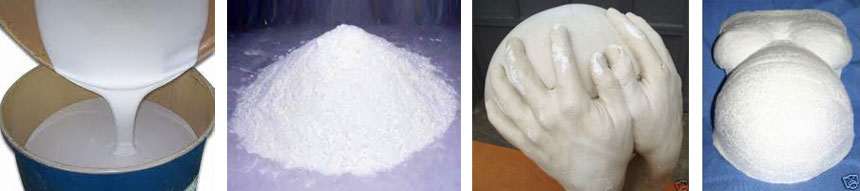
Use of Fine Casting Plaster in Alginate Moulds for Body Casting
If you want to preserve the memory of your child’s feet or hands or some other loved one, it is possible easily to do so by first using Impression Moulding Alginate to form a one use mould. Use Chromatic Alginate which changes colour as you process it from mixing to setting. Casting Plaster is then poured into the set mould thereby preserving the desired object. A more complex plaster casting procedure is necessary to create a cast of a pregnant belly or the whole torso. If you buy Alginate in our webshop, we provide full detailed instructions on how to carry out casting when using alginate to make the mould. We also have lots of life casting kits on sale in our shop with full instructions included. You can make a one-off mould with alginate to recreate any small sculpture from plaster. Please note you should NEVER put a limb or part of the body directly into plaster. It gives off heat when it is curing and can scald severely! You make a mould using alginate – and when the mould is set you pour the plaster into the mould to recreate the shape. So the hand/foot is inserted into the Alginate and NOT into the plaster.
Use in theatrical and movie sets
One of the skills used in movie and theatrical sets is that of “plasterer”, and fine casting plaster is often used to simulate the appearance of surfaces of wood, stone, or metal. It can be carved, painted and varnished.
Use in architecture
Fine Casting Plaster may also be used to create complex detailing for use in room interiors. These may be geometric (simulating wood or stone) or naturalistic (simulating leaves, vines, and flowers). These are also often used to simulate wood or stone detailing found in more substantial buildings.
Use in sculptural arts
Plaster casting directly into a damp clay mould is preferred by some artists. In creating this mould the sculptor will be working directly “in the negative”. This method requires substantial skill and experience but is quite fast and is suitable for producing shallow relief decorations. Impression Moulding Alginate can also be used to create a negative from an existing sculpture. A fine reproduction is then possible using plaster or polyurethane resin.
Modelling Plaster is also often used as an intermediate stage in the production of large cast sculptures (typically of cast bronze) or in the creation of carved stone, particularly for building decoration. The original work is usually first modelled in wet clay over a supporting structure called an armature. From this either piece moulds (moulds designed for making multiple copies) or waste moulds (for single use) would be made of plaster.
This “negative” image, if properly designed, may be used to produce clay productions, which when fired in a kiln become terracotta building decorations, or these may be used to create cast concrete sculptures. If a plaster positive was desired this would be constructed or cast to form a durable image artwork. As a model for stonecutters this would be sufficient. If intended for producing a bronze casting the plaster positive could be further worked to produce smooth surfaces. An advantage of this plaster image is that it is relatively cheap; should a patron approve of the durable image and be willing to bear further expense, subsequent moulds could be made for the creation of a wax image to be used in lost wax casting, a far more expensive process. In lieu of producing a bronze image suitable for outdoor use the plaster image may be painted to resemble a metal image; such sculptures are suitable only for presentation in a weather-protected environment.
Having Fun with Casting Plaster

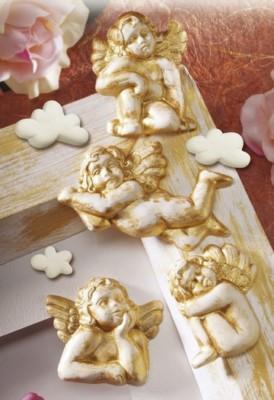
When used with a casting push mould, or rubber mould, you can have endless fun with this material. Simply mix the powder with water, pour in the mould, stir or squeeze the plaster in the mould to get rid of bubbles, then leave to dry.
You can paint the finished result with acrylic paints and add a touch of sparkle with glitter. Easily make ornaments, jewellery, fridge magnets, small sculptures and more.
Children should use plaster under supervision of adults and both should take care not to inhale the plaster powder for obvious reasons!

