Basic Instructions, information and inspiration for using Liquid Fimo Bakable Transfer Medium
Handling
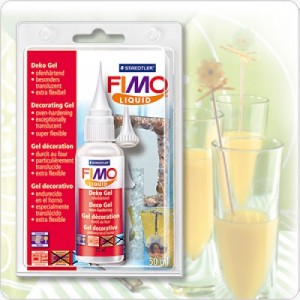 Translucent Fimo Deko Gel has the consistency of honey with a milky white app earance. Over time it does thicken slightly when stored in a closed container. To thicken it more quickly, leave it out in a polymer resistant container loosely covered with wax paper.
Fimo Deko Gel can be stored in metal, glass, wax coated paper cups, or flexible plastic containers. The plasticizers in the material will react with hard plastic or Styrofoam.
To clean up, use paper towels and rubbing alcohol. Hands can be protected by rubber gloves or barrier cream. Wash hands after using Sculpey clay and Fimo clay.
A heat gun can be used briefly to set liquid clay on curved or vertical surfaces before baking. The item must then be baked at the regular time and temperature. (Faux fiorato and lampwork beads are created in this fashion using polymer clay beads and Deko Gel.) An alternate method is to apply Deko Gel directly on baked beads “hot from the oven.” Multiple bakings are required to build the design.
For Health and Safety instructions please click here.
Baking
Bake Translucent liquid Fimo at 275˚F (130˚C) for 15-20 minutes. Note that Fimo Soft bakes at 110˚C.
Overheating polymer clays will result in blackening and the release of irritating gases including hydrogen chloride. Use an oven thermometer and timer to assure that your creation is not overheated.
Polymer clay can be baked in a home oven, however many polymer clay enthusiasts use a separate toaster or convection oven dedicated to polymer clay baking. Another option is to use a dedicated, inexpensive roaster pan (speckled enamelware) with a lid to bake clay inside your home oven. Another, even cheaper option is to take two aluminum foil baking pans: invert one over the other, and clothespin them shut. Voila, a baking container!
Transparent Liquid Fimo has more of an odour when baking than solid clays. Although polymer clay is not toxic, it is important to always bake clay in a well-ventilated area.
In thin layers fimo Deko Gel bakes to a translucent finish.Deko Gel can be applied in layers and be re-baked after each layer. Solid clay items can be baked several times. It can also be wet sanded and buffed as long as it is not too thin.
Finishing
Thicker or multiple layers of Deko Gel can be wet sanded and buffed to a very high shine. Deko Gel can also be left matte or varnished with a polymer friendly product.
Adhesive Applications
Translucent Liquid Fimo has great adhesive properties for use with polymer clay, but only when baked. By itself it is not an adhesive. Only use a thin coat, too much will cause pieces to slide. Best use for bonding raw clay to raw clay, raw clay to baked clay, or baked clay to baked clay.
Deko Gel can be used to adhere lightweight polymer elements to mixed media surfaces such as paper mache, wood, glass, or metal.
Deko Gel can be used to assist in attaching jewelry findings.
Pin Backs
Determine pin back location on piece. Spread thin layer ofDeko Gel at the placement spot. Open pin back and place on back of brooch.
Deko Gel on the side applied to the brooch. Bake.
Other Findings
Fimo Deko Gel can be used for extra security when embedding clasps, wire loops or other wire elements into raw clay.
Adding Colour
Colour can be added to Deko Gel using concentrated inks, concentrated liquid water colours, heat set inks, oil paints, dry oxide pigments, or mica pigment powders.
Oil paints thin the Deko Gel slightly; powders tend to thicken it slightly. (Concentrated inks and water colours create a more translucent colourant than do the other additives.)
Do not mix Deko Gel with acrylic paints. The water in the paint evaporates during the baking leaving bubbles and a bumpy texture. (Note: you might like this result, however, so there are no hazards to trying it.)
Stir Deko Gel with pigment in a polymer resistant container with a skewer or other mixing tool. Add pigment, mica powders, and concentrated inks very sparingly, a very small amount tints the Deko Gel quickly.
Uses for Tinted Translucent Liquid Sculpey
Paint
Tinted Deko Gel can be used as paint over raw or baked clay. Different colours can be stippled over a solid clay base and baked in stages to create a patina.
Impression Glazing
Impressions can be made in raw polymer clay with texture sheets or rubber stamps, or in baked clay with a linoleum cutter and then filled with a contrasting colour of Deko Gel.
Mosaics
Deko Gel can be used both to adhere polymer clay mosaic tiles to a polymer or other bakable base, and tinted Deko Gel can be used as a grout after the tiles have been baked in place. Tiny mosaic tiles may be made from thin sheets of Sculpey! clay, set at about a 5 or 6 (thinnest settings) on a pasta machine. After sheet has been baked, use a square punch to punch out the tiles. They will all be uniform. Triangular and other shaped decorative punches are widely available. Remember, they can only be used with baked clay sheets.
Marbling
Use a brush or skewer to make lines or dots of different colours on baked polymer clay that has been coated with a thin coat of Deko Gel. Take a pin or skewer and drag through the lines or dots to form a pattern. The same technique can be done on glass to create sheets of patterned clay.
Enamel/Stained Glass
Tinted Deko Gel can be used to imitate enamel or stained glass when contained within polymer clay borders and then baked. For enamel looks bake over a polymer clay base, for stained glass bake on glass. The enamel examples have been created by first stamping into raw clay with a simple, deeply cut stamp. Then, that piece is baked, forming a “negative” mould.
Next, foil sheets have been placed over raw clay. That foil covered sheet is then pressed into the “mold,” resulting in a “positive” with boundaries that hold the tinted Translucent liquid fimo Dko Gel.
Note that the leaf piece below has had the boundaries created with thin strands of clay “cord” created with a clay extruder. The cords are then pressed onto the leaf shape, and baked, creating tight boundaries for the Deko Gel to “puddle” into.
Other applications
Transfers
Deko Gel is an effective medium for creating very thin, flexible, translucent transfers from paper to clay using black and white or colour photocopy images (with toner) or colour laser prints (not inkjet). – Black and white images can be hand coloured with high quality coloured pencils before transferring.
Photo transfers are possible from an inkjet printer, but you must use matte photopaper, such as Great White. This is an expensive paper, so plan your images printing accordingly. Use Method 2 (soak paper backing off) to achieve good results with an inkjet printer.
Method 1
- Spread a thin, even layer of Deko Gel on a sheet of glass.
- Place transfer image toner side down into the liquid clay.
- Gently press the image into the clay starting from the center of the image. This will remove air pockets between the transfer and the clay. Allow image to rest in clay for five minutes before baking.
- Bake glass with clay and transfer paper at 275 degrees F for 15 minutes. Transfers can be baked at temperatures up to 300 degrees F which improves the colour from glossy paper and the translucence, but they may be harder to peel.
- Remove glass from oven, and while still hot, carefully peel paper from the clay. To start peeling, use a craft knife or tissue blade to separate the clay and paper. Clay will still be adhered to the glass.
- Peel paper in a smooth and gentle motion, do not tear the paper.
- Lay peeled clay transfer on a smooth, flat surface to cool. The thin transfer is now ready to be applied to clay or other bakeable surfaces using more Deko Gel as an adhesive. The transfer can also be inserted into a clay frame to enhance its translucent qualities.
Note: It is also best to photocopy the image onto a paper with a very smooth surface and low cotton content, as the fibers in the paper make it more difficult to remove the paper from the transfer after baking. Hammermill colour Copy Paper in Photo White is one brand that has a high clay content and low cotton content.
Method 2
- You may use high quality magazines whose pages contain a high level of clay for direct transfer. National Geographic, American Artist, Watercolour, are some good examples. Cut your transfer picture from the magazine.
- Spread a thin layer of Deko Gel onto the surface of the picture, taking care that it is not too thick. Let picture sit for a few minutes to “self level.”
- Bake at 275 degrees F for 15 minutes, and then remove from the oven.
- Wet the picture, and soak for a few minutes. Gently rub to remove the paper from the back of the transfer. You will ultimately have a flexible thin sheet of polymer that can be adhered or decoupaged to another surface. The effect will have a matte finish rather than the shiny surface that results from method 1.
Glaze
Deko Gel can be used as a glaze to set metal leaf, pearl ex powders, or decoupage (gift wrap papers, yuzen papers, washi papers). As a glaze it can also help reduce the appearance of fingerprints on a finished polymer piece.
Clay Softener
Deko Gel can be mixed with solid clay to soften it and make it stickier for some applications. Spackle made from a solid and liquid polymer clay combination can be used to repair cracks in finished polymer pieces.

